

How Do Lichens Contribute To Primary Succession
What Are Lichens?
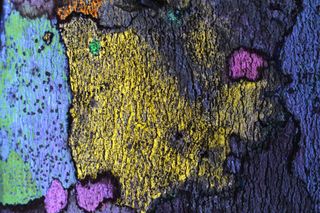
A lichen, or lichenized fungus, is actually ii organisms functioning equally a single, stable unit of measurement. Lichens comprise a fungus living in a symbiotic human relationship with an alga or cyanobacterium (or both in some instances). There are about 17,000 species of lichen worldwide.
Why grade a dual organism?
Fungi are incapable of photosynthesis considering they lack the green pigment chlorophyll. That is to say, fungi cannot harvest light energy from the sun and generate their own nourishment in the class of carbohydrates. Instead, they need to seek out outside sources of food. They blot diet from organic substances, that is, carbon containing compounds such as carbohydrates, fats, or proteins.
On the other paw, algae and cyanobacteria can bear photosynthesis, similar to plants. In fact, chloroplasts, which are the site of photosynthesis in land plants, are adapted forms of cyanobacteria. (These early cyanobacteria were engulfed past primitive plants cells old in the tardily Proterozoic, or in the early Cambrian period, according to the University of California Museum of Paleontology.)
So when a fungus, which is the dominant partner in this human relationship, associates with an alga (usually from the green algae) or cyanobacterium to form a lichen, information technology is providing itself with constant access to a source of nourishment. The mucus controls the association in a way that one could consider equally agriculture, said Robert Lücking, curator at the Botanical Garden and Botanical Museum in Berlin, Germany, and inquiry associate at the Integrative Enquiry Center at the Field Museum in Chicago. He described it every bit the controlled growth of a carbon-providing organism, simply like we grow wheat, rice or potatoes. He added that cyanobacteria also provide fungi with the boosted benefit of nitrogen fixation. This is the biochemical reaction wherein atmospheric nitrogen is converted to ammonia, a more than usable form of the element. In return, algae and cyanobacteria secure a protected surround, specially from damaging ultraviolet rays. Fungi oft form a protective cortex [or beat out] with pigments that absorb ultraviolet calorie-free, Lücking said.
Finally, equally lichens, fungi, algae and cyanobacteria are able to live in environments that they could not live in otherwise. Lücking noted that hot and common cold deserts, too as exposed surfaces, are good examples of such environments. [Gallery: Weird World of Lichen: Anything But Ordinary]
Nomenclature
The fungal component of a lichen is known as the "mycobiont," and the algal or cyanobacterial component is known as the "photobiont." The scientific name for a lichen is the same as that of the mycobiont, regardless of the identity of the photobiont. On his website defended to lichen, Alan Silverside, at present retired from the University of the West of Scotland, gives the case of the fungus Sticta canariensis . This fungus is capable of forming two different lichen associations with an alga and cyanobacterium, however both lichens are referred to equally Sticta canariensis. "If the fungus species remains the aforementioned, and so so does the name of the lichen, fifty-fifty if the lichen appearance varies," Silverside states.
Construction
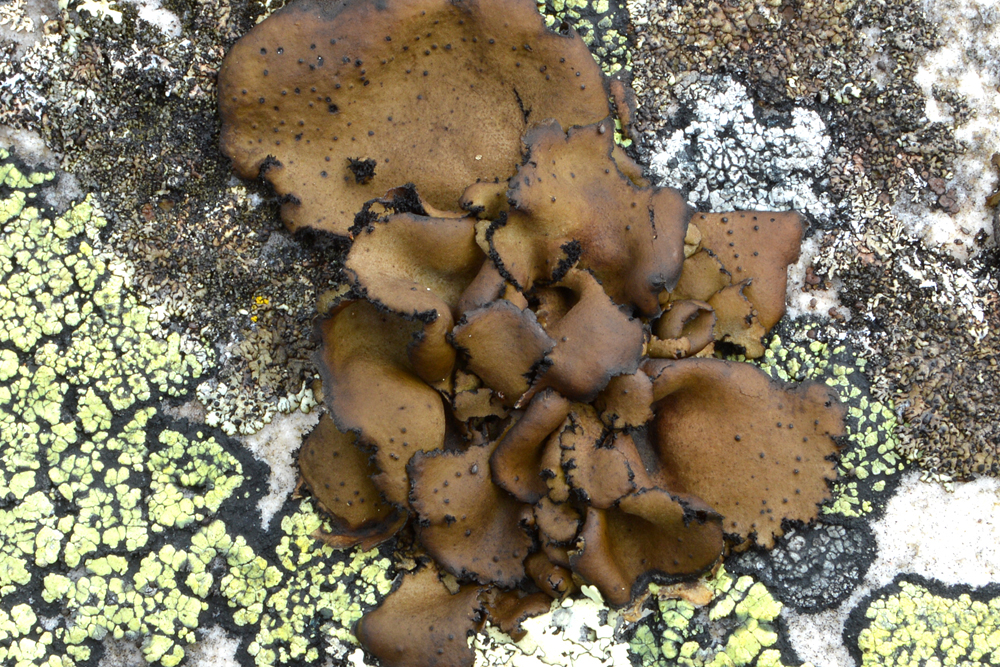
The vegetative portion of a lichen, known equally the thallus, is unknown in not-lichenized fungi, according to Lücking. Information technology is the thallus that gives lichens their feature outer appearance. Lichen thalli come in many different forms. Examples on Silverside's pages include foliose lichen, which look apartment and leafy; fruticose lichen, which have a wiry, tufted appearance; squamulose lichen, which have apartment, overlapping scales; and crustose lichen, which equally the proper name suggests, class a tightly attached crust over the surface information technology inhabits.
In full general, the inside of the lichen thallus appears stratified, with the mycobiont and photobiont cells arranged in layers. According to the U.Due south. Woods Service, the outer layer or cortex is fabricated upwards of thick, tightly packed fungal cells. This is followed by a segment with the photobiont (either green algae or cyanobacteria). If a lichen has both an algal and a cyanobacterial partner, the cyanobacteria tin can be seen within little compartments above the upper cortex. The final layer is the medulla, with loosely arranged fungal cells that wait like filaments.
Extensions below the medulla, which are chosen basal attachments, enable lichens to adhere to diverse surfaces. Typical basal attachments include rhizines, which are fungal filaments extending from the medulla, and a single, fundamental structure called the holdfast, which latches onto rocks. The Forest Service gives the instance of a foliose lichen called the umbilicate lichen, where the holdfast resembles an umbilical string.
Every bit an exception to the general thallus structure, jelly lichens do not have a layered or stratified thallus. The mycobiont and photobiont components sit down together in a single layer. As a event, jelly lichens look like jelly; for example, Collema auriforme.
Appearance
When dry, lichens simply take on the color of the mycobiont (the mucus) itself or tin be drab and gray. But when wet, they are completely transformed. This is considering the fungal cells in the upper cortex get transparent and the colors of the algal or cyanobacterial layers can shine through. Green algae bestow lichens with a bright greenish colour, while cyanobacteria requite hues of dark green, brown, or black, according to the Forest Service.
![Photosymbiodeme with green [algal] lobes growing from cyanobacterial ones.](https://cdn.mos.cms.futurecdn.net/cxewq3vS7DqAzwi5SCLT44.jpg)
Agreement the dynamic
For the mycobiont, the association with the photobiont is "obligate," or ane of dependence. "Every bit far as it is known, the mycobiont cannot persist in nature without lichenization," Lücking told LiveScience. "The mycobiont is by itself [for] only a brief menstruation when it disperses using fungal spores."
In order to create and maintain a stable clan, evolution has selected for sure characteristics within the lichen partnership. "There are three important factors for the establishment of lichens: recognition, acceptance and fitness of the association," Lücking said. "All three are causeless to undergo evolutionary selection and hence are existence optimized."
Lücking elaborated on the concept of recognition by pointing out that the mycobiont (mucus) cannot just associate with whatever given alga or cyanobacterium. Information technology actively seeks out the photobiont past chemical recognition. Acceptance occurs when the two lichen partners interact without negatively influencing one another. "For instance, if the alga considers the fungus a parasite, it will react with defense mechanisms that could prevent the establishment of a stable symbiosis," he said. "So in evolutionary terms, the two bionts take 'learned' how to interact mutually, but in a way that the fungus controls the interaction." Finally, the fitness of the relationship is adamant by healthy growth and reproductive success. "The more carbohydrates the photobiont can produce per time unit under given conditions, the faster the lichen will abound and the more competitive information technology is," Lücking said. He notes that fitness and how the lichen partners work together are dependent on environmental conditions.
Normally, once a lichen association has been established the mycobiont does not switch partners. Withal, as an exception, Lücking gives the example of Sticta canariensis, a photosymbiodeme (a fungus that can class divide lichens with different photobionts). In this case the fungus assembly with a cyanobacterium in shady, boiling conditions to class small, shrub-similar thalli. However in drier or more exposed atmospheric condition, the fungus associates instead with green algae to form large, apartment lobes. "When conditions change over time or within a brusk altitude, you lot see some individuals starting out as cyanobacterial lichens and then suddenly forming light-green lobes [by associating with light-green algae]," he said. "So the same fungal individual can switch partners ad hoc."
What isn't a lichen?
Information technology'south important to remember that any clan between a mucus and alga or cyanobacterium doesn't automatically count equally lichenization. "In lichen associations, the fungus is able to form structures unknown in not-lichenized fungi — the thallus — and the fungus also affects and changes the morphology of the photobiont," Lücking told LiveScience. "Hence, fungus-algal associations in which this is not the example are not considered lichens." He added that it is also suspected that certain non-photosynthetic bacteria are important for lichenization.
Mosses are also non lichens, according to the Forest Service. Though at starting time glance some may superficially resemble a lichen, mosses are actually primitive versions of plants and are capable of independent photosynthesis.
Importance
Lichens are key players in a diversity of environmental processes. For case, cyanobacterial photobionts participate in nitrogen fixation. Lichens also contribute to a phenomenon known equally biological weathering. The lichen mycobionts can intermission down rocks and release minerals by producing certain chemicals. Lichens tin besides disrupt rock surfaces simply by physically attaching to them, and by the expansion and contraction of their thalli, according to a 2000 article published in the journal Catena.
Weathering tin can lead to the eventual disintegration of rocks, according to the article. While this is a disadvantage, specially when lichens grow on building stones, it is too an essential stride for the formation of primitive soils. When lichens decompose, the organic matter that is left behind, forth with particles of rock and dust trapped by thalli provide material for the development of primitive soils.
The lichen species Cladonia rangiferina, unremarkably called reindeer lichen, are an of import source of winter forage for most North American caribou populations and key components of a winter nutrition (except in areas with shallow snowfall comprehend or that have mild winters) according to the Wood Service.
Finally, lichens are excellent indicators of pollution. According to the Wood Service lichens can absorb pollutants such as heavy metals, carbon and sulfur into their thalli. Extracting these pollutants gives an indication of the levels present in the temper. This process is known as lichen biomonitoring.
Source: https://www.livescience.com/55008-lichens.html
0 Response to "How Do Lichens Contribute To Primary Succession"
Post a Comment