

How To Detect Aflatoxin In Peanuts
How Aflatoxines causes liver cancer through Food
There are a lot of different mould contaminations on nutrient possible. Practise you know which moulds tin can be a problem for homo health in your products? And what is the underlying dangerous aspect of the presence of sure moulds for your products? 1 of the frequent issues with moulds on food is the fact that some of them can produce Aflatoxins. Practice you know how Aflatoxines causes liver cancer through food?
Aflatoxins are mycotoxins produced past certain moulds and tin can cause serious illness in humans and animals. The four major aflatoxins are Aflatoxin B1, Aflatoxin B2, Aflatoxin G1 and Aflatoxin G2. These toxins are produced mainly by certain strains of Aspergillus flavus and Aspergillus parasiticus and sometimes by Aspergillus nomius. Aflatoxin tin can cause liver cancer, and can lead to liver and immune-system problems. Aflatoxin B1 is the near unremarkably institute in food and is besides the virtually toxic. Aflatoxin can grow at low moisture levels (estimate minimum Aw 0.82) and over a broad temperature range (xiii – 37oC). In this blog we explain to you lot how Aflatoxines causes liver cancer through nutrient and why it's so of import to perform root crusade analyses to become rid of the Aflatoxines.
Crop related products
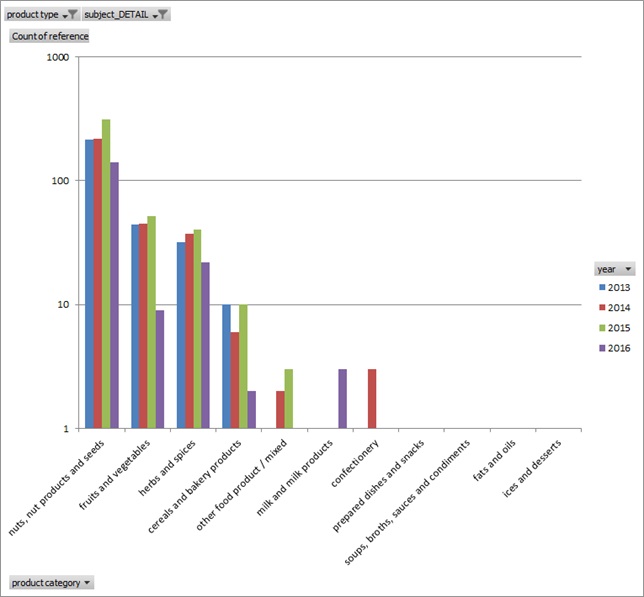
How practice you lot know if you lot have Aflatoxins that might cause liver cancer in your production? Betwixt 2013 and 2016 in that location were on average 300 Aflatoxin notifications per year in the Rapid Alert Organization Food & Feed of the European Union. Most notifications came from nuts, nut products and seeds. Beneath you see the graph of this data (using a logarithmic calibration):
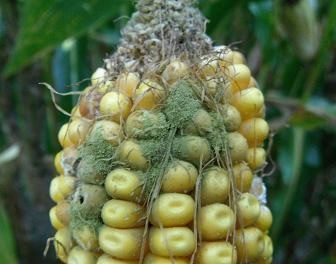
Foods in which Aflatoxins usually are plant are corn, nuts, rice, peanuts, cocoa beans, ginger, sorghum, cottonseed, tree nuts, copra, black pepper, figs, dried fruit and nutmeg. Beneath a picture is shown of mould on corn, which might requite rise to Aflatoxins. And these Aflatoxins might also cause liver cancer, that'south for the QA department to discover out.
Aspergillus flavus is normally associated with a disease of corn known as Aspergillus ear rot. Powdery, gray-dark-green spores may develop on the surface of corn ears, and aflatoxins may be produced by the fungus until the kernel moisture reaches about 15 percent. High temperatures, drought stress, and insect injury may contribute to increased aflatoxin contamination in corn.
Aspergillus flavus and Aspergillus parasiticus may crusade a illness of peanuts known every bit yellow mould, and high levels of aflatoxin contagion may result following relatively high temperatures and moderate humidity. Cottonseed, an important nutrient source for dairy cattle, may go contaminated with aflatoxins if the seed-begetting capsules (bolls) are damaged, followed past high humidity and warm temperatures before or afterwards harvest. Tree nuts such as pistachios and almonds may get contaminated with aflatoxins during injury, such as the splitting of hulls.
Aflatoxin M1, is produced by mammals subsequently consumption of feed (or food) contaminated by Aflatoxin B1. Cows are able to catechumen Aflatoxin B1 into Aflatoxin M1 and transmit it through their milk. Aflatoxin M1 may be constitute in milk and dairy products. Although Aflatoxin M1 in milk is, by far, non as hazardous equally the parent compound, a limit of 0.five parts per billion is applied, largely because milk tends to constitute a large part of the diet of infants and children. Milk must be routinely tested for this substance.
Low levels of Aflatoxin and liver cancer
In most cases the contamination of nutrient products with aflatoxins is present at low levels. These low levels exercise normally non cause firsthand health effects on humans, but do have a longer term affect when consumed regularly. This is one of the principal reasons why aflatoxins are so underestimated.
Aflatoxin contagion has rarely occurred in foods at levels that cause acute aflatoxicosis in humans. Aflatoxin acute and chronic exposures are more than probable to occur in developing countries where less strict regulatory limits, poor agricultural practices in food handling and storage, malnutrition, and disease are issues. Co-ordinate to the 'Bad bug book' Aflatoxicosis in humans has been reported in many countries, including India, China, Thailand, Ghana, Kenya, Nigeria, Sierra Leone, and Sudan.
Prevention of Aflatoxines
How tin you lot preclude people getting liver cancer or other diseases through aflatoxin in your product? Unfortunately we are non in control of the conditions. The accumulation of aflatoxin is dependent upon conditions weather. Before harvest, the risk for the development of aflatoxin is greatest during major droughts. When soil moisture is below normal and temperatures are high, the number of Aspergillus spores in the air increases. These spores infect crops through areas of harm caused by insects, and inclement weather. One time infected, constitute stress occurs, the product of aflatoxin is favoured. We practice take influence on the storage environment. It is of import to storage your product under the right temperature and humidity and then the Aspergillus cannot produce aflatoxins.
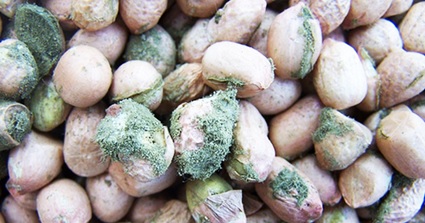
What do y'all need to practise if you have aflatoxin in your product? Aspergillus often looks green to the naked optics, aflatoxins are odourless, tasteless and colourless. Aflatoxin is stable and heat resistant. It is Not possible to inactivate aflatoxin by heating your production. It is hard to eliminate aflatoxin once it is produced. When you have aflatoxin in your product and it is above the maximum level than the only pick is to destroy the product.
Regulatory background of Aflatoxines
A lot of countries have maximum levels of aflatoxins laid down in regulations. The Codex Standard 193-1995 mentions the maximum levels of aflatoxins and the sampling plans.
On the website of FAO the worldwide regulations for mycotoxins in food and feed 2003 are mentioned. http://world wide web.fao.org/docrep/007/y5499e/y5499e00.htm
Romerlab has besides mentioned on their website the Worldwide Mycotoxin regulations. Delight follow the link if yous desire more information about these regulations. https://www.romerlabs.com/en/cognition-eye/knowledge-library/manufactures/news/worldwide-mycotoxin-regulations/
Another overview of maximum toxin levels in food for several countries tin can exist establish here: http://www.mycotoxins.info/myco_info/consum_regu.html
Detection of Aflatoxins – a breakthrough
Until recently the most common ways to notice aflatoxins in your product were the ELISA method,liquid chromatography (LC) with fluorescence detection. For quantification or identification purposes the latter is usually extended with LC/mass spectrometry (MS) or LC/MS-MS.
2017 the International Crops Inquiry Institute for the Semi-Barren Tropics (ICRISAT) developed a low price detection method for aflatoxins on location. This is a breakthrough that will help in the early detection of the presence of aflatoxins in crops already during the harvest. For more information see the post-obit video and website:
http://www.icrisat.org/starting time-portable-low-price-device-developed-for-rapid-detection-of-aflatoxins/
Maybe you also like to read almost:
5 Secrets to foreclose Salmonella
Tin Norovirus Live on Nutrient
Listeria Monocytogenes
Source: https://www.foodsafety-experts.com/food-safety/aflatoxin-detection/
0 Response to "How To Detect Aflatoxin In Peanuts"
Post a Comment